
Rhea Jail Release Routes
The Rhea County Sheriff's Department operates the adult jail at the Justice Center and processes people arrested in the county. A true community release may follow bond, a court order, time served, sentence expiration, or placement on supervision. The Sheriff's physical-custody transaction is the key record because it marks when jail staff carried out the exit. A court docket can explain the legal authority, but a signed order may precede departure while staff verify identity, paperwork, and outstanding holds.
A transfer also closes the Rhea County Jail stay. It does not mean the person entered the community. A person received by the Tennessee Department of Correction, another county jail, the U.S. Marshals Service, or ICE remains in custody. Temporary movement to court or medical care may leave legal custody unchanged. Ask for the release type and receiving agency, not just a date.
| Rhea custody event | Best confirmation | Next check |
|---|---|---|
| Bond or court release | Sheriff release time | Clerk's bond order and pending docket |
| Local sentence completed | Jail transaction and sentence record | Court judgment or supervision order |
| Transfer to TDOC | Receiving-agency entry | TDOC FOIL |
| Federal or ICE transfer | Named receiving agency | USMS, BOP, or ICE route |
Confirm a Rhea Jail Release
The Sheriff links an inmate portal from its official navigation, but research found no separate official recent-release archive or declared period for keeping past bookings online. Use that portal to test whether a person appears in current county custody. Absence alone proves nothing. It may reflect release, transfer, data lag, a name mismatch, or a custody episode that has already left the live interface.
- Collect the full legal name, date of birth, booking number if known, and approximate booking dates.
- Check the Rhea hosted inmate portal only for present custody.
- Call the jail through the published numbers and extension 2. Ask for the departure time, type, and receiving agency.
- Request the existing booking-and-release record when a written answer is needed.
- Match the transaction with the court case, TDOC FOIL, or the named receiving agency.
A person who disappears from the Rhea roster is not automatically free. Confirm where physical custody went.
Names can collide. Match at least two identifiers, such as date of birth, booking number, case number, or TOMIS number. A photo can help separate namesakes, but it should not replace record identifiers.
Rhea Jail Release Records
Ask the Sheriff's records custodian for the available booking-and-release report rather than assuming a local database uses a particular title. A narrow request should identify the person and custody period, then seek the booking date and time, exact release date and time, release type, court or authority reference, charges recorded at release, and destination when another agency received the person. Request the photograph associated with that booking separately if needed.
The Tennessee Public Records Act governs access, subject to exceptions and requester rules. The research found no Rhea-specific online request form or fee set specifically for release records. The Sheriff's published prices for incident and one-page incident or arrest reports do not establish the cost of a release log or booking photo. Ask for the current policy and an estimate before costs are incurred. Existing records may be inspected or copied; the agency need not create a new analysis.
- Release transaction
- The jail's dated entry showing how the physical stay ended.
- Receiving agency
- The custodian that took control after a transfer.
- Detainer
- A request or legal basis for another authority to hold or receive the person.
- Disposition
- The court's result in a case, which is not always the same date as physical release.
County retention guidance distinguishes agency retention from web display. Tennessee's sheriff records schedule gives booking, sign-out, and movement census records a five-year benchmark. Identification files include photographs, while the signed and witnessed property-return receipt has a permanent benchmark. None of those periods promises public online access.
Proof Around Rhea Release
The Sheriff's jail description supplies an unusual administrative trail. Staff tag and secure personal property at booking and place money into an inmate trust account. Property is returned upon release, and trust money is returned by check that the person signs for. Release papers and those receipts can support the dated custody transaction when the public roster no longer shows the booking.
The official jail source also describes the bond process. When bond is set, the person receives a qualified-bondsmen list and can call the company of choice. Jail staff set an initial court date and explain the duty to report. Posting bond ends that physical jail episode, but it does not dismiss the case. The clerk's docket remains the place to check later settings, conditions, and final disposition.
The official capture below shows the Sheriff source used for jail contact and release-related property procedures.
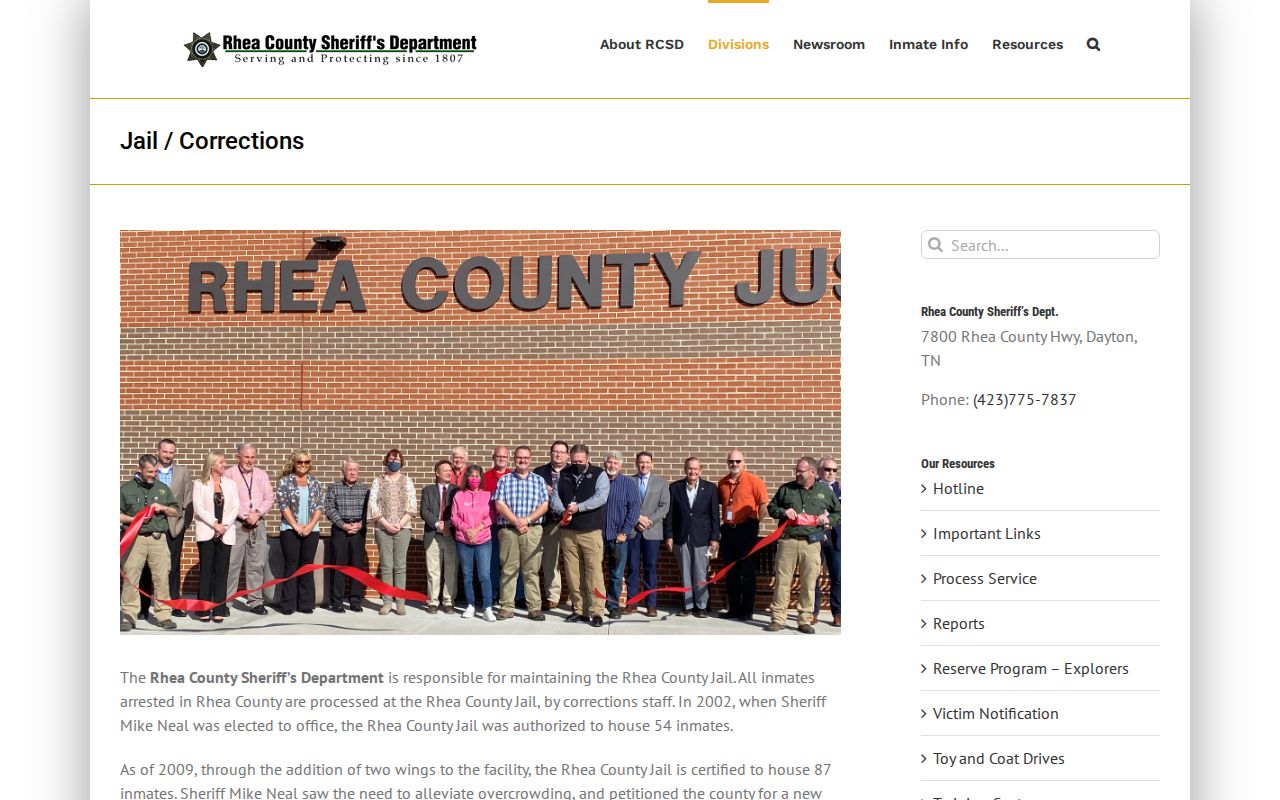
That page identifies the operator and process, while the person-specific transaction must still come from the Sheriff's records.
Rhea Jail's Two Eras
Facility history must be dated carefully. The Sheriff's older jail account describes authorization for 54 beds in 2002 and additions that brought certified capacity to 87 by 2009. Its old average-population and work-release figures describe that earlier operation. They should not be treated as the design or current count for the newer building.
A separate county announcement says the $23.6 million Rhea County Justice Center opened in March 2021 with a 342-bed jail, courts, and space for justice-related offices. An April 2025 TDOC snapshot listed 294 people, including federal and TDOC backup categories. Those are one-month population figures, not annual releases. They show why transfer questions matter in Rhea County: people at one physical site may have different legal custodians and different follow-up systems.
Historic work release is another important distinction. A judge-sentenced participant allowed out for a work assignment remained housed at the jail. A daytime sign-out was temporary movement, not a final release from Rhea County Jail custody.
Rhea Jail Records Contact
Public contact details route requests to the Sheriff's Department. Custody operations continue beyond public lobby hours, but the listed public office schedule is the time to seek records guidance. Telephone staff may limit what can be given by phone. If so, ask for the records custodian and the method for requesting the existing transaction.
Rhea County Sheriff's Department / Jail7800 Rhea County Highway
Dayton, TN 37321
423-775-7832, 423-775-7837, or 423-775-7838
Extension 2 for the jail
Fax: 423-775-5463
Public hours: Monday-Friday, 9 a.m.-5 p.m.; holidays closed
For the judicial reason behind release, the Rhea Circuit Court Clerk holds the bond order, judgment, dismissal, probation order, or revocation in the case file. The Sheriff documents the actual custody exit. The two records answer different questions and should be reconciled when timing or another hold matters.
Match Rhea Release Orders
A court order explains why release was authorized, while the Rhea County Jail transaction shows when staff carried it out. Ask the Rhea Circuit Court Clerk for the specific case judgment, bond or release order, dismissal, probation or split-sentence order, or revocation record. Use a docket or case number when known. The clerk can state its inspection, certification, and copy process for the requested case.
A favorable result on one charge may not end custody if another case or detainer remains. Likewise, a bond docket entry may appear before identity checks, release papers, and hold checks are complete. Compare the court's effective order with the exact Sheriff's timestamp and receiving-agency field. That comparison distinguishes legal authority from the actual exit.
The Justice Center area brings the jail, courts, and supervision offices close together, but their records remain separate. The Sheriff owns the physical-custody record. The clerk owns the court result. TDOC or SETHRA owns the applicable supervision entry. One office should not be asked to certify another office's data.
Specify Rhea Release Fields
A focused records request helps staff identify the existing transaction. Give the full name, date of birth, approximate booking and release dates, and booking number if known. Ask for identifiers, admission time, arresting or committing agency, charges, case number, release timestamp, release type, authority reference, bond entry, and receiving agency. Protected personal or operational details may be redacted under an applicable exception.
If the response omits the destination, ask whether another agency took custody. If it omits the photograph, request the image tied to that one booking because the same person may have several episodes. Preserve the source, record number, and date received. A later roster check cannot replace the dated agency response.
Search Public Records
Sponsored Results