
Rhea Projected and Actual Release
A projected date is a calculation, not proof that someone walked out. Tennessee corrections records may distinguish a release-eligibility date, sentence expiration, a parole effective date, and the actual release transaction. Eligibility is the first date a qualifying person may be considered for parole or another statutory release path. Sentence expiration is the computed end of the sentence under the governing law and credits. A Board grant still requires an approved plan and release processing.
The actual Rhea County release date and time comes from the agency that executed the custody change. For a county jail episode, that is the Sheriff's booking-and-release transaction. For a TDOC prisoner, it is the TDOC release record. A transfer can close one facility's record while custody continues under another agency, so the receiving destination matters as much as the timestamp.
A pretrial detainee has no sentence-based projected release date. Bond, a judge's order, dismissal, plea, trial, or another hold determines what happens. Even a signed order may precede physical release while jail staff verify the paperwork and check for detainers.
Find Rhea Projected Release Dates
Start with custody class. The TDOC Offender Search, known as FOIL, covers felony offenders currently or formerly in TDOC custody or supervision. A short Rhea County misdemeanor stay may never appear there. For that case, the jail and sentencing court are the better sources. Use identifiers such as date of birth, TOMIS number, booking number, and docket number because names alone are not unique.
- Identify whether the person is pretrial, serving a county sentence, in TDOC custody, or already on parole or probation.
- For a TDOC felony record, search FOIL by last name and use TOMIS ID when known. Match the correct person before opening the detail.
- Copy each date label exactly. Do not rename eligibility or sentence expiration as “projected release.”
- For a qualifying felony held locally, use TDOC Sentence Information and select the County Jail/Sentence Information route.
- For a county misdemeanor sentence, request the judgment and credit entries from the Rhea court and ask the jail for its release computation.
- Check for consecutive terms, holds, parole action, or amended orders. Then confirm actual departure with the custodian.
The Rhea County Sheriff's jail line is reached through 423-775-7837, extension 2. Public hours are Monday through Friday, 9 a.m. to 5 p.m., with holidays closed. Ask for the release date and time, release type, and receiving agency rather than asking staff to predict a case outcome. The full Rhea County released-inmate record path shows how to reconcile the jail transaction and court disposition.
Note: A future FOIL date should be recorded with its exact label and the date on which the record was checked.
Rhea FOIL Sentence Date Labels
FOIL can show status, location, offenses, sentence data, parole-hearing status, and release information. Read status and location first. “Incarcerated” with a facility means custody continues. “Parole” or “probation” indicates community supervision, not unconditional discharge. “Inactive” means the TDOC episode is no longer active, but its detail and dates must show why and when.
The public interface requires a last name and permits first name, TOMIS ID, race, sex, and age to narrow a search. A TOMIS number identifies a person in the Tennessee Offender Management Information System. Uncertain demographic filters can hide a true match, so begin narrowly and add only reliable details.
| Date or status | What it answers |
|---|---|
| Release eligibility | Earliest date an eligible person may be considered under the controlling rule |
| Sentence expiration | Computed sentence end, subject to the full sentence structure |
| Parole grant or effective date | Board action and planned start, still subject to an approved release plan |
| Actual release | Agency transaction confirming departure from that custody |
| Inactive status | TDOC record is not active; detail is needed to identify discharge or another reason |
The official FOIL name and TOMIS search illustrates the state entry fields used for a Rhea County felony offender.
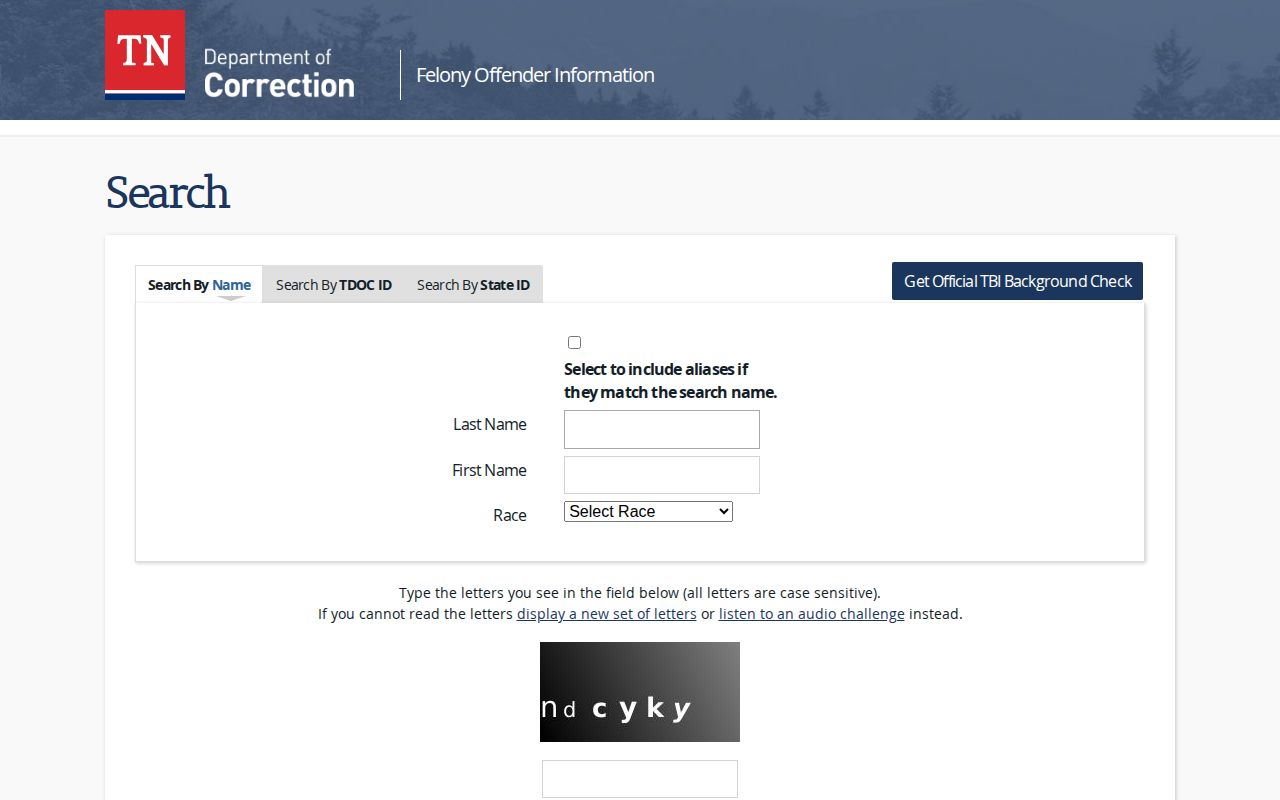
The search screen leads to the individual detail record, where the live labels must be preserved instead of replaced with a generic phrase.
Rhea Release Eligibility Percentages
Tennessee Code § 40-35-501 sets release eligibility through offense-specific and date-specific rules. In applicable cases, baseline range percentages include 20 percent for an especially mitigated offender when the judgment is silent, 30 percent for Range I, 35 percent for Range II, 45 percent for Range III, and 60 percent for a career offender. These points open eligibility for consideration. They do not guarantee parole or set the physical release time.
The familiar “85 percent rule” is not universal. Historical § 40-35-501(i) requires service of 100 percent for listed offenses, less retained credits that cannot cut service by more than 15 percent. That creates an 85 percent floor for those cases. Later provisions can require the full sentence without reduction or allow program credits to affect eligibility without moving expiration. The offense, offense date, classification, exclusions, and current statutory text control.
Consecutive sentences also change the calculation. Under § 40-35-501(m), their ineligibility periods are calculated separately and added. Discipline can defer eligibility. Subsection (r) places sentence-expiration and eligibility calculations with TDOC for every TDOC felony offender and each felony offender serving at least one year in a local jail or workhouse. Informal arithmetic is therefore a poor substitute for the official Rhea felony-date route.
Rhea Sentence-Reduction Credit Rules
Tennessee Code § 41-21-236 supplies the general sentence-reduction-credit framework. It authorizes up to 16 days per month in eligible circumstances, with up to eight days tied to satisfactory institutional conduct and up to eight tied to satisfactory program performance. The awards require written documentation, statutory eligibility, and review. They are not automatic. Discipline, punitive segregation, or qualifying maximum-security periods can prevent awards, and credits can be removed through the prescribed process.
Offense dates matter again. For some offenses before July 1, 2024, and qualifying shorter later sentences, credits can affect dates as the law provides. For sentences longer than two years for conduct on or after July 1, 2024, the current framework generally applies credits to parole eligibility instead of altering sentence expiration. Education and treatment credits also have exclusions.
Section 41-21-236(d) extends the framework to felony offenders serving a year or more locally and treats the jail official as warden for that purpose. Subsection (f) permits local misdemeanor credit under local or system rules. No Rhea County-specific award rate was found. A county inmate should not be promised a fixed number of days. The judgment, jail credit, applicable rule, and official computation are the sources.
Why Rhea Release Dates Change
A future date can move even when the record was read correctly. Some changes come from the sentence calculation. Others come from a new legal event or another agency's hold. Ask which field changed, which authority changed it, and when the system was updated. That approach is more reliable than comparing two screenshots without context.
| Factor | Effect on the release path |
|---|---|
| Credit award, loss, or restoration | May alter eligibility or expiration where the governing statute permits |
| Disciplinary action | Can prevent credits or defer eligibility |
| Consecutive sentences | Add separate ineligibility periods and extend the total structure |
| Amended judgment or jail-credit correction | Changes the legal data used in the computation |
| Parole grant, denial, or rescission | Changes whether and when conditional release can proceed |
| Detainer or receiving agency | Can turn release from one custodian into continued custody elsewhere |
| Release-plan approval and processing | Can separate a Board action or date from physical departure |
A detainer is a request or legal basis for another agency to take or retain custody. A Rhea jail entry that says “released to TDOC,” “released to USMS,” or “released to ICE” is a transfer, not freedom in the community. The receiving agency becomes the next source. A court order can also authorize release on one case while another active case keeps the person confined.
Note: When two systems disagree, ask whether they describe separate custody episodes or use different update times before treating either as wrong.
Rhea County Sentence Computation
County custody requires a different split. A pretrial detainee waits on bond, court order, or case disposition and has no sentence-based release estimate. A sentenced misdemeanor term belongs with the court judgment and the jail's computation. A felony offender serving at least one year locally falls within TDOC's statutory sentence-calculation role, which is why the County Jail/Sentence Information route exists.
The court file can contain the judgment, sentence length, jail credit, split-confinement order, revocation, and amended judgment. The jail record shows when staff executed release after checking the papers, identity, and holds. Tennessee jail-management rules require current inmate records with confinement date, sentence length, statutory reductions, and release date, as well as written procedures for warrants, detainers, release to another officer, release-paper checks, and property return.
Weekend and holiday assumptions should be avoided. The Sheriff's published lobby hours do not establish when custody releases occur. No Rhea-specific weekend-release rule or fixed local processing schedule was found. Call the jail for the actual transaction and use the official computation for the expected sentence event.
Rhea Parole Date Is Conditional
The Board of Parole hearing calendar is not a release schedule. Hearing officers make recommendations, while Board members issue the final action. A scheduled hearing proves no grant. A grant also does not mean the gates opened because TDOC requires approval of a release plan before physical release. FOIL may show an individual hearing status, and the final order can be requested from the Board.
Parole is supervised release before sentence expiration. Probation is a court-ordered community sentence. A determinate release can place a qualifying short felony sentence on statutory probation at the eligibility point. These labels affect which date matters, which agency verifies it, and whether a person remains under supervision after leaving a facility.
Confirm Rhea County Release Dates
Confirm a county release with the Sheriff's dated booking-and-release transaction. Ask for the exact time, release type, and receiving agency. Confirm a state-prison event with TDOC and FOIL. If detailed historical material is needed, TDOC accepts archived requests through its online portal or Records Management at 320 6th Avenue North, Nashville. Archive-search charges may apply, and TDOC says not to prepay.
VINELink can provide an alert when a participating agency reports a custody change, but a notice is a prompt to verify. Delivery can lag, and a transfer may be the event. The Rhea County VINELink check explains how to match one record and register for release or transfer notifications. A final answer still comes from the custodian's actual transaction and, when relevant, the receiving agency.