
Rhea Federal Custody Paths
No BOP prison or ICE detention center was identified in Rhea County. Federal custody can still touch the county through a federal hold, a person housed under contract, or a transfer after a local booking. An April 2025 TDOC jail snapshot counted 50 people in a federal category at Rhea. That figure is a one-month population count. It does not establish BOP designation, an ICE contract, annual federal releases, or the status of any named person.
The first task is to read the Rhea County Jail transaction. Ask whether the person entered BOP custody, was received by USMS, or was transferred to ICE. The word “federal” is too broad to choose a locator. A sentenced BOP prisoner, a defendant awaiting federal trial, and an adult in immigration detention belong to different systems.
| Custody class | Primary path | Release proof |
|---|---|---|
| Sentenced federal prisoner | BOP Inmate Locator | BOP Released status/date plus docket as needed |
| Federal pretrial detainee | Federal docket and USMS district route | Detention or release order and custodian confirmation |
| Current ICE detainee | ICE ODLS and ERO | ICE location or agency confirmation |
| Rhea jail federal transfer | Sheriff release transaction | Receiving agency and timestamp |
Search Federal Prison Releases
The BOP Inmate Locator searches federal inmate records primarily from 1982 forward. Search by BOP register number, DCDC number, FBI number, or INS number. A name search accepts first, middle, and last name, with race, age, and sex available to narrow the results. An agency identifier is stronger than a name alone.
- Gather the full name, federal register or case number, birth information, and approximate custody dates.
- Search by the strongest federal identifier available, then try the exact name.
- Match register number and demographics before opening or relying on the result.
- Read release date and location or status together.
- Compare the result with the federal docket and any later-custody evidence.
The successful manifest capture below illustrates the official federal locator used for a sentenced BOP record.
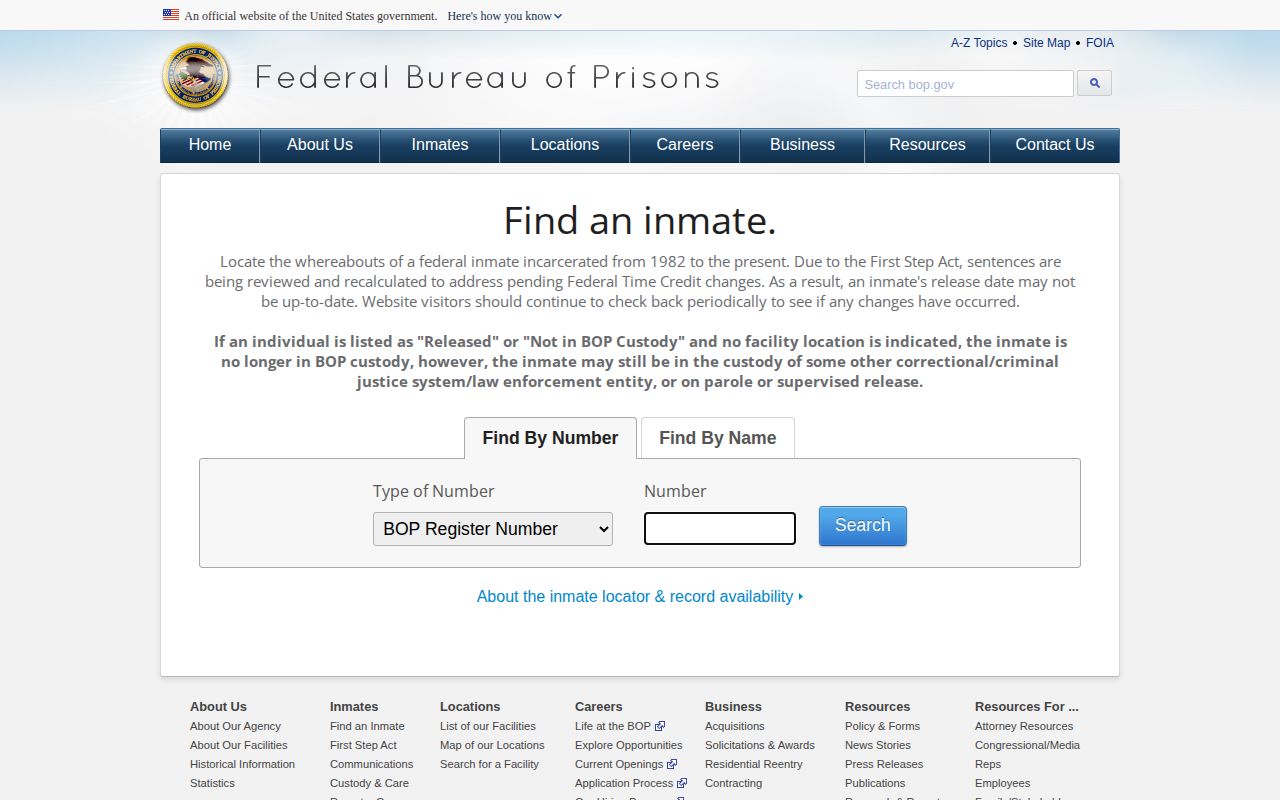
The locator supplies federal search fields and result context, but it does not replace the court docket or another agency's later custody record.
Read a BOP Release Result
BOP explains that a past release date, no listed facility, and “RELEASED” means the person is no longer in BOP custody. “Not in BOP Custody” also speaks only to that agency. A person can remain on federal supervised release or enter state, county, or immigration custody later. The result should not be broadened into a claim that no sovereign has custody.
- Released
- The BOP custody episode shown by the locator has ended.
- In Transit
- The person is moving within custody, not released.
- Unknown
- A status that may reflect pretrial, unsentenced, or undetermined confinement.
- Projected date
- A future calculation that can change before actual release.
- Supervised release
- Court-ordered federal supervision after imprisonment, distinct from BOP confinement.
A future date is not a physical release transaction. BOP notes that First Step Act time credits and sentence-review recalculations can affect projected dates. The judgment, sentence computation, detainers, and later agency action all matter.
A BOP “Released” result confirms exit from BOP custody, not freedom from every agency.
Rhea USMS Pretrial Movement
The U.S. Marshals Service prisoner-operations program manages federal pretrial detention and movement. USMS may use local contract beds, so a federal defendant with a Rhea connection can be held outside the county and outside a BOP prison. USMS does not provide a nationwide released-person locator comparable to BOP.
A Rhea County Jail notation such as federal hold or release to USMS means only that Rhea's physical custody ended. Use the federal court docket for the detention order, release order, judgment, and conditions. The Eastern District of Tennessee USMS route is the local district contact path. After sentencing and designation to BOP, the BOP locator becomes more useful.
For records not available in the docket, USMS has a federal records request route. Frame the request around a specific person, case, date range, movement, or custody action. Privacy and identity requirements can limit disclosure, especially when requesting a person-specific file.
Check Rhea ICE Transfers
The ICE Online Detainee Locator System, or ODLS, is designed for adults currently in ICE detention and limited recent-release information. It searches by A-number and country of birth, or by exact biographical name, date of birth, and country of birth. It is not a complete historical federal-release archive.
If the Rhea County Jail record says “released to ICE” or identifies an immigration detainer, the correct interpretation is transfer into federal civil custody. Ask the Sheriff for the receiving agency and timestamp, then use ODLS. If no result appears and the system directs contact with Enforcement and Removal Operations, follow that route. A failed search must not be used to infer immigration status or release.
No verified source established that Rhea County Jail has an ICE detention contract. The federal category in the jail snapshot does not prove one. Avoid collapsing ICE, USMS, and BOP into a single federal inmate search.
Federal Release Record Sources
The locator result is only one layer. The federal docket supplies detention and release orders, the judgment, sentence, and supervised-release terms. For a detailed former BOP inmate file, use the BOP records request process and follow its identity and privacy authorization requirements. For releases before 1982, follow BOP's National Archives instructions because locator coverage is primarily from 1982 onward.
A useful request names the person and register number, identifies the custody dates, and asks for the specific release or transfer record. Do not ask an agency to infer whether another sovereign later held the person. Instead, build the custody sequence from each agency's own entry.
| Record | Question answered |
|---|---|
| BOP locator result | What BOP status and release date are displayed? |
| BOP former-inmate file | What detailed BOP release or transfer material exists? |
| Federal docket | What did the court order, and what supervision followed? |
| USMS confirmation | Who held or moved a pretrial defendant? |
| ICE ODLS or ERO response | Is current ICE detention confirmed? |
Resolve Federal Custody Conflicts
Systems can appear to disagree because they cover different dates or agencies. A person can leave Rhea custody for USMS, enter BOP after sentencing, later show Released from BOP, and then remain under court supervision. Another person can move from the county jail to ICE without ever entering BOP custody. Place each record in date order before deciding whether there is a conflict.
Record the time each dynamic source was checked. Match at least two identifiers, such as date of birth, federal register number, A-number, or case number. When an entry is unclear, ask the agency that created it for the effective date and the meaning of its status label. The office with physical custody is the first source for present location, while the signed federal order explains judicial authority.
For a Rhea-origin transfer, begin with the Sheriff transaction because it names the next custodian. For a sentenced federal release, begin with BOP. For pretrial movement, begin with the docket and USMS. For evidence of immigration custody, begin with ODLS and ICE. That division prevents a negative result in one locator from becoming an unsupported release claim.
Build a Federal Release Timeline
Start the timeline with the last Rhea County Jail transaction or federal court order. Add the receiving agency, transport or designation stage, BOP admission when applicable, sentence dates, projected fields, actual release result, and any supervised-release term. Each source should contribute only the event it owns. A county entry cannot certify a later BOP release, and BOP cannot certify the end of a later ICE detention.
Dates need labels. “Released to USMS” is a receiving-agency event. A BOP future date is projected. A past BOP Released result marks the end of that BOP episode. An ICE locator match addresses present civil detention. Keeping those labels intact makes the chain clear even when the person crossed several systems.
If there is a gap, use the federal docket, BOP file, USMS records route, or ICE contact that corresponds to that gap. Do not fill it with an assumption based on a missing web result.
Older Federal Release Files
BOP locator coverage is primarily from 1982 forward. A person released earlier may require the National Archives path described by BOP. A former-inmate file can also contain more detail than the locator result. Follow BOP's identity, authorization, and privacy instructions, name the register number when known, and ask for a defined record and period.
For a pretrial person who never entered a BOP sentence, a BOP search can remain empty or unhelpful. The federal case and USMS route remain primary. For a person transferred into immigration detention, ODLS and ICE own that later phase. Choosing the record by custody class is more reliable than repeating a name across unrelated locators.
Search Public Records
Sponsored Results