
Rhea Parole and Probation Compared
Parole is conditional release from a prison sentence before its expiration. The Tennessee Board of Parole decides whether to grant it, and Tennessee Department of Correction Community Supervision monitors the person after release. Probation is a community sentence ordered by a court. It may start at once or follow a short period of split confinement, which means part of a sentence is served in jail and the rest in the community. Someone who merely posts bond is not automatically on either form of supervision.
The distinction affects the verification route. A parole status should connect to a Board action and a TDOC record. A Rhea County probation term should be supported by the signed judgment or probation order from the court that imposed it. FOIL, Tennessee's Felony Offender Information Lookup, can show parole or probation for people within TDOC's felony system, but it does not cover every local misdemeanor case.
| Point | Parole | Probation |
|---|---|---|
| Source | Board release from a prison sentence | Court-ordered community sentence |
| Primary record | FOIL status and final Board action | Signed judgment or probation order |
| Supervision | TDOC Community Supervision | TDOC or the named local program |
| Physical release | Requires an approved release plan and processing | May start without a prison release |
Several terms are easy to confuse. Their exact meanings keep a supervision check tied to the right record.
- Discharge
- The formal end of a custody or supervision term.
- Absconder
- A person whom the supervising authority alleges has stopped reporting or cannot be located.
- Revocation
- An official action that can end parole or probation and return the matter to custody or court.
- Split confinement
- A sentence divided between confinement and supervised community time.
Verify Rhea Post-Release Supervision
Begin with the TDOC Offender Search. FOIL covers felony offenders currently or formerly in TDOC custody or supervision. A result may list incarcerated, parole, probation, or inactive status. Match more than a name. TOMIS number, date of birth, age, and other record details help avoid a false match. Read status and location together because an inactive state record does not rule out a new county booking.
- Search by last name and first name. Use the TOMIS number when known.
- Open the matching detail record only after checking identifiers. Do not rely on a photo alone.
- Read the exact status. Parole and probation mean community supervision, while incarcerated means custody continues.
- Use the TDOC Field Office Directory to find the office serving Rhea County.
- For court-ordered probation, request the signed order from the Rhea Circuit Court Clerk. It states the sentence and conditions.
- Ask the office for public confirmation or the proper records route. Private reporting details may be withheld.
FOIL is not a live warrant system. It also does not show every short county sentence. When the state result is sparse, the court order identifies who imposed supervision, while the assigned office can route an appropriate verification request. The broader Rhea County released-inmate search explains how to reconcile the jail release record with court and TDOC sources.
Note: Match two identifiers before connecting a Rhea County parole or probation record to a person with a similar name.
Rhea County Supervision Offices
TDOC lists a Community Supervision reporting location at the Rhea County Justice Center. The office serves felony probation and parole matters routed through TDOC. A caller may provide a name and TOMIS number and ask what public status can be confirmed. The published number is for routing and verification, not for seeking private schedules or case-management notes.
TDOC Community Supervision
Rhea County Justice Center
7794 Rhea County Highway
Dayton, TN 37321
Phone: 423-634-4662
Fax: 423-634-6364
Rhea County also has SETHRA Community Corrections and Misdemeanor Probation at 7800 Rhea County Highway, Suite 665, Dayton, with phone 423-775-3643. That program should not be treated as TDOC felony parole. The judgment or supervision paperwork determines which office applies. Co-location near the jail and courts makes the offices easy to confuse, but it does not merge their roles or records.
For probation imposed in a local case, the Rhea Circuit Court Clerk can provide the controlling order. The clerk's office is at 7824 Rhea County Highway, Dayton. The official state directory lists 423-775-7818. Ask for the judgment, probation or split-confinement order, and any later revocation or amended order tied to the docket.
Rhea County Parole Decisions
A parole hearing is not a release. Hearing officers act as fact finders and make nonbinding recommendations. Board members may adopt, change, or reject them. Some actions require three concurring votes, most violent conviction offenses require four, and revocation decisions require two. Even after a grant, TDOC says the release plan must be approved before physical release takes place.
The Tennessee Board of Parole hearing page is the official route for current instructions. It says state-prison and county-jail schedules are updated each Monday, or Tuesday after a Monday holiday. Rhea County Jail may appear when an eligible person is set there. A schedule proves only that an event was planned. FOIL may show an individual hearing status, but no separate statewide results database was verified.
The captured official parole-hearing explanation shows how Tennessee presents Board review and calendar access.
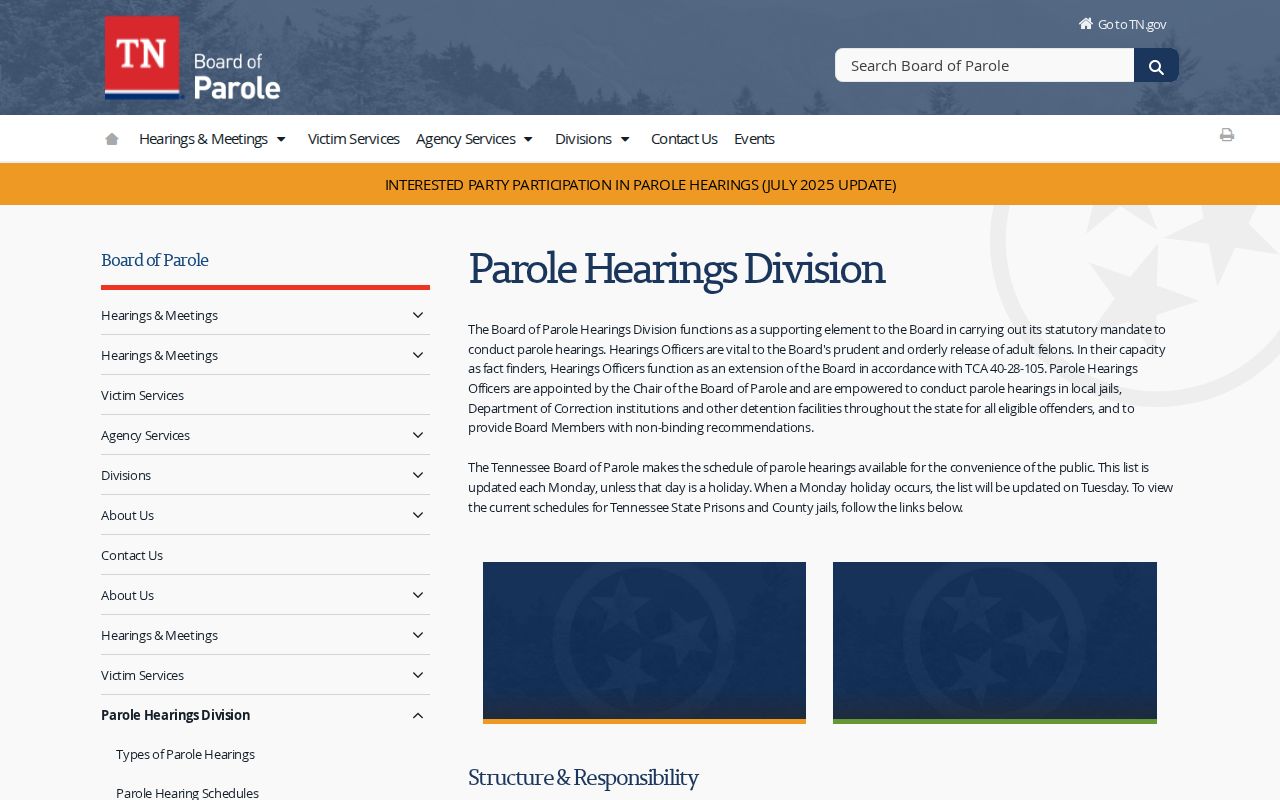
The image is a starting point for the current process, while the person's final order remains the key decision record.
For the actual order, vote, outcome, or final-action date, use the Board public-records request process. Include the offender name, TOMIS number, hearing date, and hearing type. The Board says email to BOP.Webmail@tn.gov is fastest and generally responds within seven business days or states when records can reasonably be made available.
Rhea Supervision Warrants and Absconders
No official statewide TDOC public absconder list was verified, and the Rhea County Sheriff's site did not show a county parole-absconder list. An absconder label is an allegation by the supervising authority that the person stopped reporting or cannot be located. It does not prove a new conviction. FOIL may show a supervision status, but it must not be read as a real-time warrant search.
Questions about a suspected warrant belong with the court or the law-enforcement agency responsible for it. Do not infer a warrant from a missing jail roster entry. The person could be compliant on supervision, discharged, transferred, or held elsewhere. If safety is at issue, contact law enforcement and do not try to approach or monitor the person.
Note: A revocation hearing can lead to revocation or reinstatement, so the hearing type and final Board action both matter.
Rhea County Reentry Supervision
The Rhea County Sheriff reentry announcement describes education and recovery work at the Justice Center, including adult basic education, Celebrate Recovery, anger management, parenting, substance-use education, and relapse-prevention classes. These programs occur within the local custody and reentry landscape. Participation does not by itself show parole, probation, or discharge. The official supervision record still controls.
Tennessee law also creates forms of supervision that do not fit a simple prison-versus-probation split. TDOC's Types of Release material says a person placed on probation or released from split confinement must report within 48 hours. Determinate release can place a qualifying short felony sentence on statutory probation at its eligibility point. For qualifying offenses committed on or after July 1, 2021, Tennessee Code § 40-35-506 can require reentry supervision near or after sentence expiration.
These rules make one phrase especially risky: “sentence expired” does not always mean “no supervision.” Some specified offenses also carry community supervision for life under Tennessee Code § 39-13-524. The exact judgment, offense date, statute, and FOIL status must be read together before describing how a Rhea County supervision term continues.
Rhea Release Property Record
The Sheriff's jail material gives Rhea County an unusual administrative trail around physical release. Property is tagged and stored at booking. Trust money is returned by check, and the released person must sign for it. Tennessee's county retention schedule treats the signed and witnessed property-return receipt as a permanent record. It can support the fact that a physical release process occurred, although it does not prove whether later parole or probation remained active.
That receipt should not replace the booking-and-release transaction, court order, or supervision record. Each has a separate job. The jail record gives the actual custody exit and receiving agency. The court states the legal order. FOIL and the correct office show post-release supervision, while a formal discharge record establishes when that supervision ends.
Rhea County Supervision Discharge
Supervision ends through a formal discharge, sentence completion, court action, or another statutory process. An inactive FOIL status can signal that TDOC's active episode ended, but the dates and detail must explain why. It should not be translated automatically as a recent release or a clean end to every case. A later arrest can create a separate custody episode.
For parole, request the final Board or TDOC record showing the action and date. For probation, obtain the court record and any completion or discharge entry. A person can finish physical confinement while supervision continues, and a person can finish one case while another hold remains. The safest conclusion names the agency, status, and effective date shown by the record rather than assuming that all legal restraint ended at once.